Checking compression on an E-profile silicone seal
A caliper reading across a loose E-profile can include the foot that sits inside the retaining groove. Using that overall height to calculate door compression counts part of the foot as working travel. Seat the sample in its groove and choose a reference surface that can be located in both door positions.
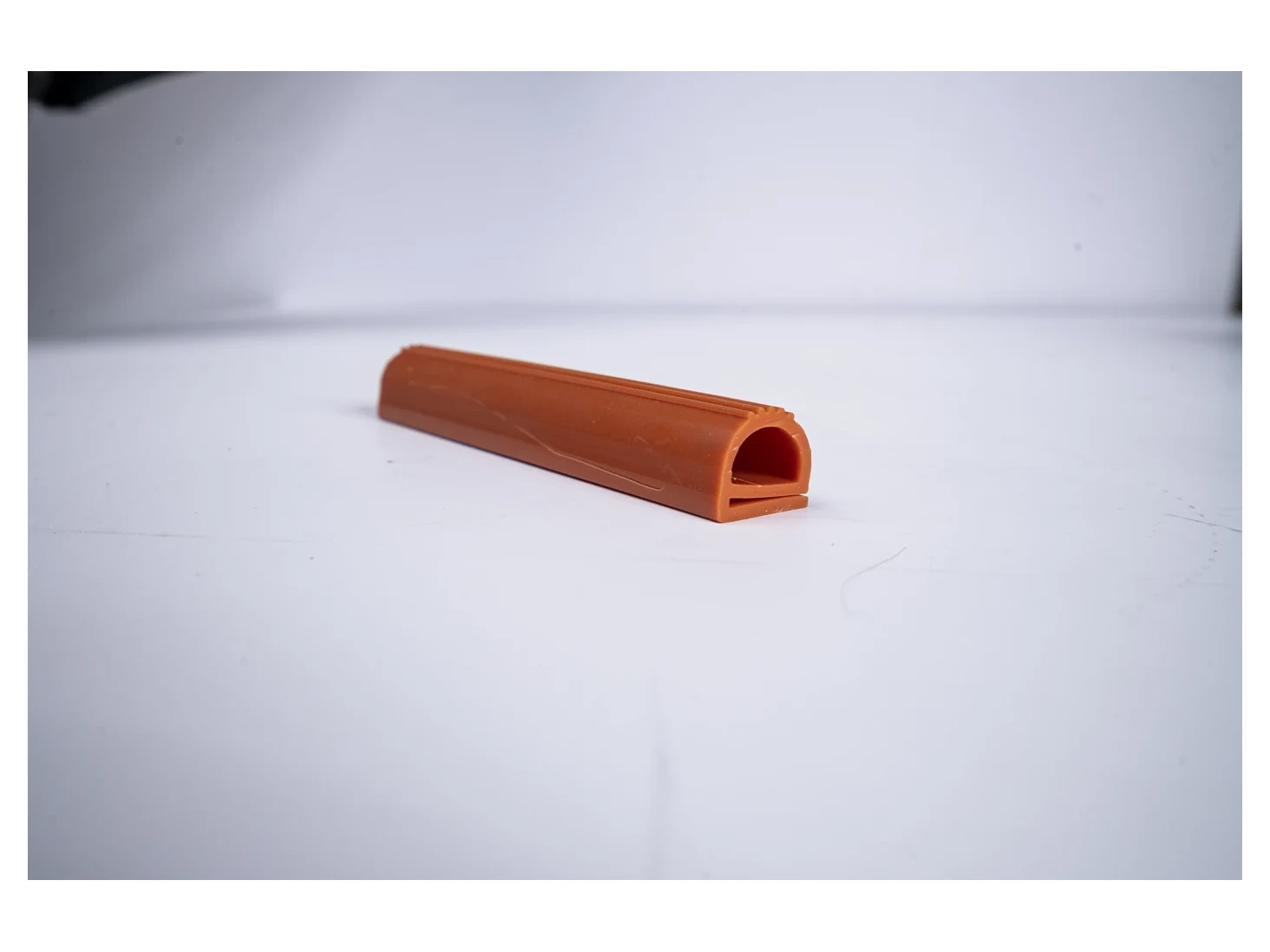
Take both measurements from the same surface
With the door open, measure along the closing direction from the mounting datum to the top of the fitted seal. Call this free projection H. From the same datum, measure the distance G to the opposing face in the latched position. If access is limited, use a suitable gap gauge or reproduce the position of the mating face in a fixture. Record the measuring direction at each point.
Calculate deflection and test closing effort separately
For a face compressing the seal squarely between locally parallel surfaces, geometric deflection is H − G. Percentage compression is (H − G) ÷ H × 100%. An illustrative 8 mm projection and 6 mm closed gap give 2 mm of travel, or 25%. This is a calculation example. A negative result indicates remaining clearance. Wall thickness, cavity shape and compound affect closing force, so test the intended travel with the actual sample.
Repeat the check under the service cycle
Record separate readings near the hinge and latch. Look for side rubbing, a rolled lip or a foot lifting from the groove. For an oven door, give the supplier the temperature cycle, closed duration and cleaning method to review the proposed compound. After opening the door, remeasure the projection at an agreed interval. Consistent timing makes recovery observations comparable across samples.